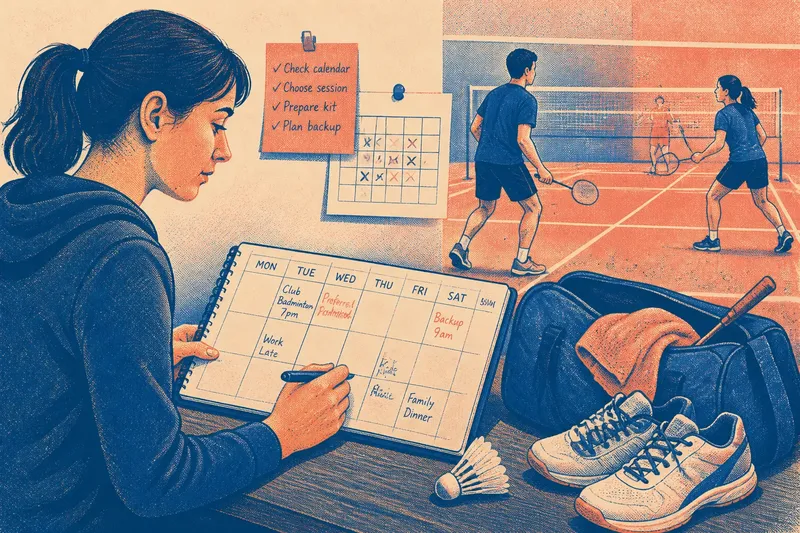
The Club Volunteer Rota Before the Group Chat
A club volunteer rota makes shared duties visible, clarifies who is doing what, and helps members coordinate without relying on scattered messages.
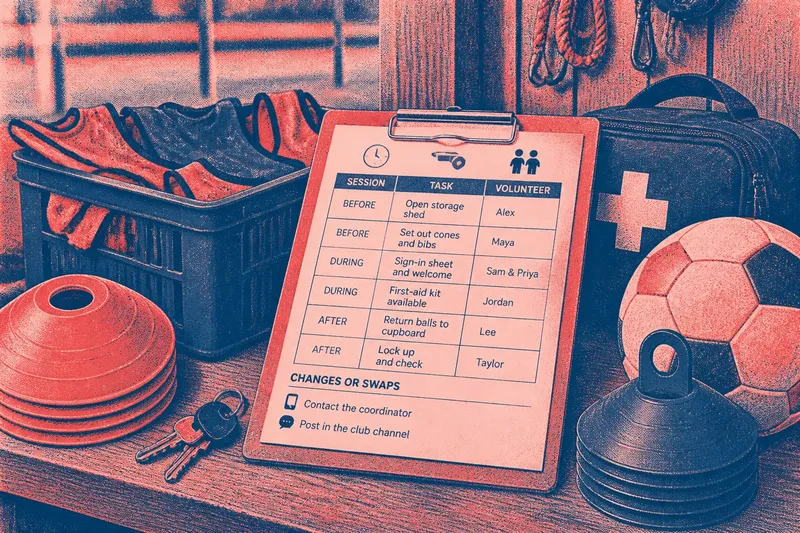
A club volunteer rota can stop the same few people from quietly carrying every small job. Before a group chat fills with reminders, a clear rota gives members one place to see what needs doing, who has agreed to do it, and how to flag a change.
That visibility matters because club work often begins informally. Someone brings the keys, another puts away cones, and a familiar parent stays to tidy. These arrangements can feel easy while the group is small, but they become harder to track as attendance changes and tasks multiply. Building a rota is not about turning a club into an office. It is about making the shared work plain enough for people to take part fairly.
What work is happening without a name beside it?
Start by noticing the work the club already relies on. Think beyond the obvious jobs listed on a fixture sheet. A session may also need someone to open the storage shed, set out bibs, check the sign-in sheet, collect equipment, lock up, or bring a first-aid kit from its usual place.
For a week or two, keep a simple note of recurring duties and occasional ones. Ask the coach, team manager, and members who regularly stay behind what they handle. The aim is not to audit anyone’s effort or count every minute. It is to catch the small, easily forgotten tasks that make a session run smoothly.
Separate duties that must happen from tasks that are simply helpful. A court or field may need to be left clear, for example, while sorting spare water bottles might be useful but optional. This distinction prevents a rota from quietly turning every kind gesture into a standing obligation.
How should you decide what belongs on the rota?
Make a working list, then group tasks by when they happen: before the activity, during it, and at the end. Keep each item concrete. “Help out” is difficult to schedule; “put the training bibs in the equipment bag after practice” gives a volunteer a clear finish point.
For each job, note whether it requires access, a particular skill, or a decision from a club officer. Ordinary setup tasks can often be shared broadly. Tasks involving children’s supervision, money, transport, equipment maintenance, or an official club role may need a specific person and an approved process. Do not place safety-critical work on a general rota or ask an unqualified volunteer to take it on.
Where a duty depends on club policy, the item’s label, manufacturer instructions, or local rules, follow that guidance and ask the appropriate club officer or qualified professional if needed. A rota assigns agreed work; it does not replace training, authorization, or sound judgment.
Also distinguish a task from a role. “Return the balls to the locked cupboard” is a bounded task. “Be responsible for all equipment” is a role with ongoing decisions and follow-up. Roles should not be slipped onto a volunteer through a rota without a clear conversation about what they involve.
Who can take each duty, and how often?
Before assigning names, ask members what they can realistically offer. Some people can arrive early but need to leave promptly. Others can help after practice but cannot attend every week. A rota works better when it respects those limits instead of treating every person’s availability as interchangeable.
Offer choices rather than presuming that the most visible members are the only ones willing to help. A new member might prefer a short, clearly explained task alongside someone who knows the routine. A long-standing member may welcome handing a job over once its steps are written down. Pairing people for an unfamiliar duty can help share practical knowledge without making one person its permanent owner.
Set a rhythm that fits the club’s actual calendar. A regular session might use a repeating sequence, while a club with changing fixtures may need to set duties separately for each event. The paper rota on a noticeboard, a shared document, and a club’s existing messaging tool can all work; choose the simplest option members can reliably access.
Keep the rota legible at a glance. Put the date or session first, followed by the task and the volunteer’s name. If two people share a duty, name both and say what each is handling. Think of it like a labeled coat hook: the point is not decoration, but making it obvious where something belongs.
How do you build a rota people can use?
Draft the first version from the duty list and the availability people have actually offered. Leave space for a substitute or a note about how to report a change. If the task needs a handover, add a brief cue such as where the equipment is kept or who has the key. Keep private contact details off any rota displayed publicly.
Check the draft with the people who will use it. Ask whether a task is vague, whether the timing is workable, and whether any job has been assigned to someone who cannot do it. A short review at practice or in the club’s established communication channel is usually more useful than polishing a complicated template in private.
Imagine a small running club whose members have been taking turns bringing route markers, but no one knows who will collect them after the session. The coordinator lists “bring markers” and “return markers to the club box,” asks who can manage each, and puts the names beside the next meeting. Members can then see that the jobs are separate, and the coordinator can ask for a replacement early if one person cannot attend.
That example is deliberately modest. A rota need not capture every spontaneous act of kindness. It should make recurring commitments visible, while leaving room for members to help one another without assuming that an unplanned favor will happen every time.
What should the rota say about changes?
A plan is useful only if people know what to do when it no longer fits. Agree on a simple route for reporting an absence or asking for a swap, such as contacting the named coordinator or posting in the club’s usual channel. The rota should make that route clear, rather than leaving each volunteer to guess whom to tell.
Make the person holding the rota responsible for updating it when a change is agreed. That prevents one member’s private message from leaving everyone else looking at an outdated assignment. If the club uses a group chat, treat it as a way to notify people of a change, not as the only record of who has agreed to do what.
When a duty is missed, first check whether the person was absent, the task was unclear, or the rota itself was difficult to find. A calm follow-up can reveal a fix: clearer wording, a reminder at the right time, or a different volunteer arrangement. Public blame rarely helps members offer their time again.
How can you tell whether the rota is helping?
After it has been in use for a while, ask a few practical questions. Can volunteers tell what they are expected to do? Are important duties still being left uncovered? Does one person keep filling gaps? Can someone who misses a session find out how to hand over their task?
Use the answers to adjust the arrangement, not to grade people. A club may discover that a duty needs to be split, moved to a different part of the session, or dropped because it is not necessary. It may also find that one volunteer prefers a predictable recurring task while another wants occasional, short commitments.
How should you explain the rota to members?
Should every club task appear on the rota?
No. Include recurring duties that the club depends on and that can be assigned clearly. Leave informal, optional offers off the rota so that generosity does not become an unspoken permanent commitment.
What if someone cannot do their assigned duty?
Use the agreed swap or absence route and update the shared record once a replacement is confirmed. A rota should make a change visible, not make a member feel unable to report one.
Can a new member volunteer for a task?
Yes, if the job is appropriate, clearly explained, and does not require access or qualifications they lack. Pairing a newcomer with an experienced member can make the first contribution easier to understand.
Does a group chat replace a rota?
A chat can carry reminders and quick updates, but messages can become hard to find. Keep the agreed assignments in a stable, accessible place and use the chat to point members to changes.
What makes the arrangement fair over time?
Fairness does not mean every member must do identical work. People have different schedules, abilities, confidence, and access to transport or equipment. A fair rota makes the available contributions visible, offers meaningful choices, and avoids repeatedly assigning inconvenient duties to whoever is least likely to object.
Review assignments when membership or the season’s demands change. Invite feedback privately as well as in a group setting; some members may be reluctant to say in front of others that a task is difficult or inaccessible. If a volunteer repeatedly fills gaps, acknowledge the pattern and look for a shared solution rather than treating their reliability as an unlimited resource.
A club volunteer rota is most useful when it stays modest: a clear list of necessary work, names attached by agreement, and a sensible way to handle changes. Put the current version where members can find it before practice, then revisit it whenever the duties or the people doing them shift. The group chat can carry the reminder; the rota is what lets everyone see the work behind it.